Short answer: most Baltimore County tree removals run between $400 for a small ornamental and $3,500 or more for a large oak over a roof. This guide breaks down real local price ranges by tree size, explains what moves the number up or down, and shows you how to get the exact price — in writing, free — before you commit to anything.
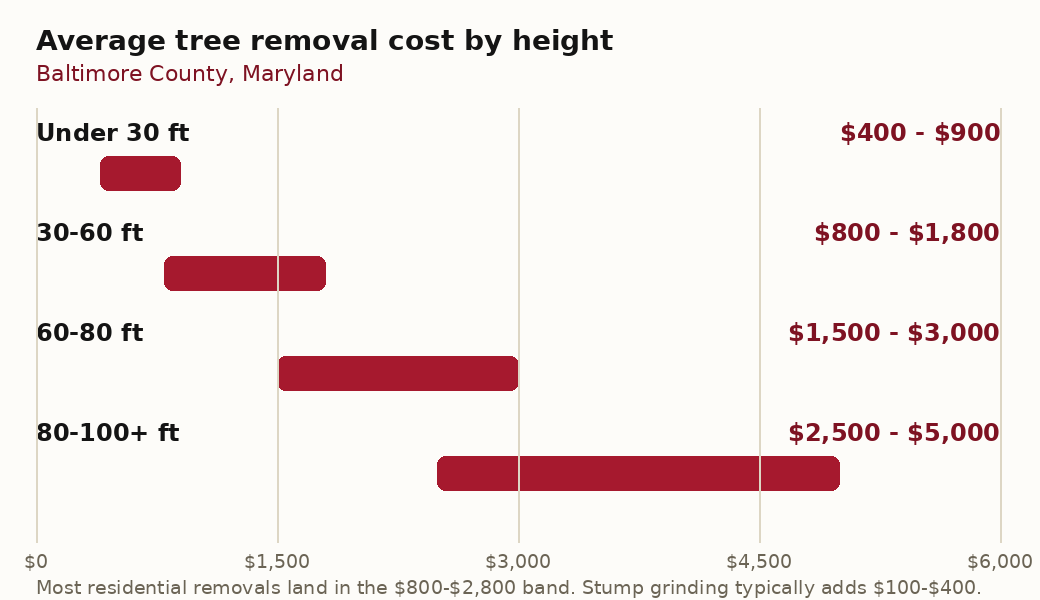
Height is the single biggest driver of price, because taller trees mean more wood, more rigging, and more time. Trunk diameter matters almost as much — a fat 50-foot oak can cost more than a skinny 70-foot pine. Here is what Baltimore County homeowners typically pay:
| Tree height | Typical examples | Average range | With stump grinding |
|---|---|---|---|
| Under 30 ft | Dogwood, redbud, small maple | $400–$900 | $500–$1,300 |
| 30–60 ft | Mature maple, pine | $800–$1,800 | $900–$2,200 |
| 60–80 ft | Oak, tulip poplar | $1,500–$3,000 | $1,600–$3,400 |
| 80–100+ ft | Mature white oak | $2,500–$5,000+ | $2,600–$5,400+ |
Some jobs need a crane — a very large tree, a tree too dead to climb safely, or a tree with no drop zone at all. Crane work adds cost (the crane and operator are billed into the job), but it is often faster and gentler on your property than a full day of sectional rigging, and for the biggest trees it is the only safe option. Crane jobs start around a $2,500 floor. If your tree needs one, it will be spelled out in the written quote, not added later.
Want a ballpark for your specific tree right now? Run the 60-second cost calculator — no email or phone number required to see the result. The instant estimate page prints all the same ranges as plain text, including emergency and lot-clearing numbers.
Two trees of the same height can differ in price by a factor of two. Here's why:
Stump grinding is almost always quoted as its own line item, so you only pay for it if you want it. Most single stumps run $100–$450; a stump 36 inches or wider usually runs $400–$800. Grinding is priced by diameter — roughly $2–$5 per inch measured across the stump at its widest, including the root flare — with a minimum charge for grind-only visits (the grinder still has to get to your yard). Multiple stumps on one visit are priced as a package, and the per-stump cost drops quickly. Full details are on our stump grinding page.
Pruning runs $250–$1,500 depending on the size of the tree and how much wood comes out; most single residential trees land between $350 and $1,200. Deadwood removal on a small tree sits at the low end; a full crown reduction on a mature oak is at the high end. If you're deciding between pruning and removal, read our remove-or-trim decision guide — and see the trimming & pruning page for what a proper pruning visit includes.
After-hours and storm work costs more than scheduled work, for straightforward reasons: crews are pulled out at night and in bad weather, hazard pay applies, and the work itself — a tree resting on a roof, under tension — is slower and riskier than a planned removal. Emergency removal of a tree off a structure commonly runs from about $1,500 into the several-thousand range depending on size and damage. The good news: when a tree damages a covered structure, homeowners insurance typically pays for the damage and for getting the tree off the structure, with a separate removal limit that is commonly $500–$1,000 per storm. Our insurance and storm-damage guide explains exactly what is usually covered and what to document. For a tree down right now, see emergency storm cleanup or call (443) 873-3338 — the line is answered 24/7.
Most Baltimore County homeowners removing a tree on their own land don't need a county permit — but there are real exceptions: trees in the public road right-of-way need a state permit, properties in the Chesapeake Bay Critical Area (within 1,000 feet of tidal water — common in Dundalk, Essex, and Middle River) have tree rules with replacement requirements, and many HOA communities require their own approval first. The full, plain-English breakdown is in our Maryland tree permits & rules guide, and anything that applies to your property gets flagged at the free estimate.
Not by zip code. The pricing model is the same from Dundalk to Columbia — height, diameter, condition, access, and targets. A waterfront tree in Essex costs more than the same tree in an open Parkville yard because of the dock underneath it and the rigging it demands, not because of the town line. Crane work, buffer-zone paperwork, and tight access are the honest price drivers anywhere in Baltimore County.
Every range on this page is a planning number. The exact quote is a different thing: an estimator walks your property, measures the tree (height, trunk diameter, lean, and condition), maps what's underneath it, and works out the access route for equipment and debris. You get a written, itemized price — removal, stump grinding, and haul-away as separate lines, so you can approve exactly the work you want — good for 30 days, with no obligation and no charge. If the tree can be saved with pruning instead, the quote says that, with the pruning price next to it. That's the whole model: real numbers, in writing, before anyone starts a saw.
Most 60-foot oaks in Baltimore County land between $1,500 and $3,000. The swing factors are trunk diameter, how much of the tree hangs over the house, and whether a crane is needed. Stump grinding adds $100–$400. Your exact price is free and in writing after an on-site look.
Because two trees of the same height can be very different jobs. Diameter, species, condition, backyard access, and what's underneath the tree — roof, wires, fence, dock — all change the labor and the risk. That's why honest companies quote on site instead of over the phone.
No — it's quoted as a separate line item so you only pay for it if you want it. Most stumps run $100–$400 to grind, priced by diameter. You can also have it done on a later visit.
Usually only when a tree damages a covered structure like your house or garage. Policies typically include a removal limit of $500–$1,000 total per storm. A healthy tree that falls in the yard with no damage is often not covered. Our insurance guide walks through the details.
Late winter — January through March. Tree companies' schedules open up after the holidays, the ground is often firm or frozen (easier on your lawn), and dormant-season work is the healthiest timing for the trees that stay.
No. On-site estimates are always free, and the price you get is written and good for 30 days. If a tree can be saved with pruning instead, we'll tell you that instead of quoting a removal.
Ready when you are: tree removal · stump grinding · trimming & pruning · contact us